


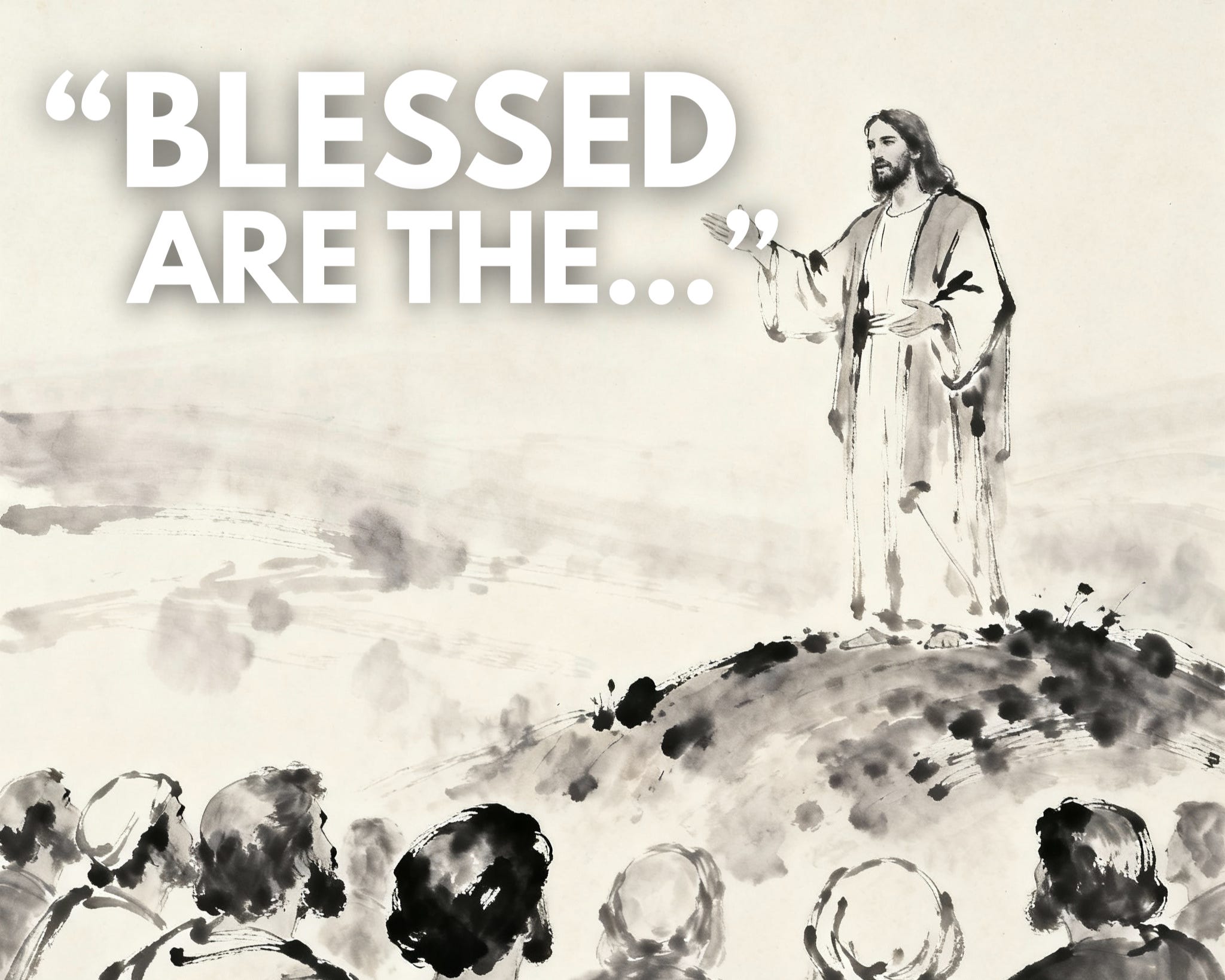
When we think of Jesus’ most famous teaching moments, the Sermon on the Mount often tops the list. There are few words of Jesus’ that are as well-known in our society today. The Beatitudes (”Blessed are the poor in spirit,” “Blessed are the meek, etc.”) are some of the most quoted lines in history.
But here is a question that might surprise you: Did Jesus simply come up with these sayings? Was this akin to an original speech from Christ himself? Or was he actually doing more to reinforce and drive home existing teachings?
While Jesus is God Incarnate and certainly speaks with His own authority, He didn’t just pull these concepts out of thin air. He was doing something that every good teacher of the Word does: He was using Scripture.
Even the God incarnate Himself referred to His own written Word to teach the people.
The Beatitudes and Their Ancient Roots
If you look closely at the opening of the Sermon on the Mount, you will find that it is deeply woven with the threads of the Old Testament. Jesus wasn’t replacing the Hebrew Scriptures; He was amplifying them.
Let’s look at the side-by-side comparison of some of Jesus’ words and the Old Testament prophets and psalmists.
Matthew 5:3
“Blessed are the poor in spirit,
for the kingdom of heaven is theirs.”
Compare this to Isaiah 57:15.
For the High and Exalted One,
who lives forever, whose name is holy, says this:
“I live in a high and holy place,
and with the oppressed and lowly of spirit,
to revive the spirit of the lowly
and revive the heart of the oppressed.
Other Bible versions such as the NRSV use the terminology of “the contrite and humble in spirit” in place of “the oppressed and lowly of spirit.” Either way, Jesus’ words echo Isaiah’s here. God dwells in his Kingdom, and those who are “lowly of spirit” will dwell there with Him.
Matthew 5:4
“Blessed are those who mourn,
for they will be comforted.”
And what does Isaiah 61:1-2 tell us?
1 The Spirit of the Lord God is on me,
because the Lord has anointed me
to bring good news to the poor.
He has sent me to heal the brokenhearted,
to proclaim liberty to the captives
and freedom to the prisoners;
2 to proclaim the year of the Lord’s favor,
and the day of our God’s vengeance;
to comfort all who mourn,
Jesus is clearly citing the one of the promises about him in Isaiah 61. All who mourn will be comforted by the Messiah.
Matthew 5:5
“Blessed are the humble,
for they will inherit the earth.”
This one is virtually a direct quote of Psalm 37:11.
“But the humble will inherit the land
and will enjoy abundant prosperity.”
There’s not a whole lot to add there. Once you’re aware of Psalm 37:11, it’s easy to see it’s clearly being referenced by Jesus here. Now let’s jump ahead a little bit.
Matthew 5:8
“Blessed are the pure in heart,
for they will see God.”
Take a look at Psalm 24:3-4.
3 Who may ascend the mountain of the Lord?
Who may stand in his holy place?
4 The one who has clean hands and a pure heart,
who has not appealed to what is false,
and who has not sworn deceitfully.
The one who has clean hands and a pure heart may stand in the presence of God, where, as Jesus says, “they will see God.”
These are just a few examples. The broader Sermon on the Mount is saturated with references to the Law, the Prophets, and the Psalms.
Why This Matters for the Modern Church
Recognizing that Jesus quoted the Old Testament isn’t just a fun trivia fact; it has two major implications for how we practice our faith today.
1. The Standard for Preaching
If Jesus—the very Word of God made flesh—found it necessary and useful to study, memorize, and pull from Scripture to inform His sermons, how much more does that apply to human preachers?
Jesus didn’t rely solely on original, “off-the-cuff” wisdom. He anchored His teaching in the text. This sets a clear bar for our leaders today: If you attend a church where the pastor never references Scripture, it might be time to find a new church.
2. The Danger of “Un-hitching” the Old Testament
There is a popular trend among some modern Christians to identify strictly as “New Testament” believers. Some go as far as neglecting the Old Testament entirely, or viewing the God of the Old Testament as incompatible with the Jesus of the New Testament.
This isn’t a new idea. It is actually an ancient heresy known as Marcionism.
In the 2nd century, a man named Marcion taught that the “vengeful” Creator God of the Old Testament was separate from and opposed to the “loving” Father of Jesus.
The early church rejected this teaching vehemently. The church father Polycarp famously called Marcion the “firstborn of Satan.” Strong words for the leader of a dangerous heresy.
This heresy also doesn’t stand up to scrutiny when we look at Jesus’ own regard for the Old Testament scriptures. If the Old Testament God was truly opposed to Jesus, why would Jesus hold the Old Testament Scriptures in such high regard? Why would He build His most famous sermon upon Old Testament books such as Isaiah and the Psalms?
Conclusion
Jesus did not come to abolish the Old Testament; He came to fulfill it. Shortly after preaching the Beatitudes and referring to this array of Old Testament scriptures, Jesus says this plainly, in Matthew 5:17.
“Don’t think that I came to abolish the Law or the Prophets. I did not come to abolish but to fulfill.”
Jesus is the one who can carry these Old Testament words to their intended conclusions. When we read the Sermon on the Mount, we aren’t just reading something new. Rather, we’re hearing the source of these words Himself provide illumination to them.
So the next time you read the Beatitudes, remember: You are reading a Master Teacher handling His very own inspired words with precision.
Well done.
I've long been aware of these details, as I've tried to consider the entire Bible holistically from the very beginning of my Christian walk, but thank you for the reminder.
This is good.
Jesus stated that he did not speak of his own authority but only what he had heard from the Father. The Father has been speaking to his people through the Law and the prophets, and now lastly through his Son. It should be no surprise that Jesus repeats and emphasizes what God has already revealed, as well as bringing new revelation and new insight. "Search the Scriptures, for they speak of me."