


This week I received this comment on a post on Instagram:
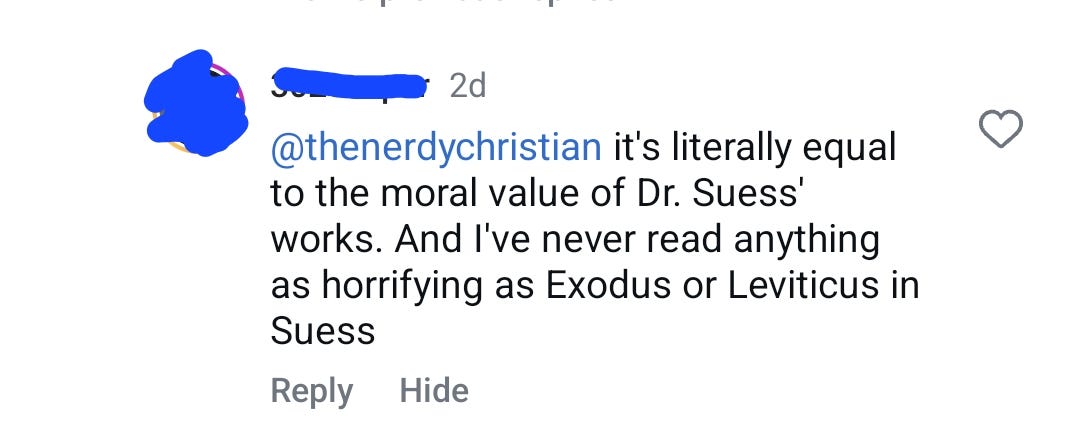
I knew what was coming in the following comments: a narrow range of cherry-picked verses which ignored the ancient context of the original authors, along with an either intentional or honest ignorance of the reasonable apologetic responses to them. I was right in my prediction. It was just a few comments later that laws about slavery in Exodus 21 and Levitical laws about eating shellfish or wearing mixed fabrics were brought up.
The Boogeyman Books
For reasons such as this, many Christians shy away from these books of Scripture, or even attempt to ignore them altogether. The “We don’t talk about Bruno” of American Christians is: “We don’t talk about Levitical Law.”
However, this is an extremely sad reality to me, brought about by us allowing skeptics and critics of Scripture and Christianity to draw and limit focus to an extremely small range of difficult passages, at the expense of some absolutely beautiful passages within the whole of the Books of the Law.
There are plenty of difficult passages within these books, particularly if we read them plainly with a Western eye without any knowledge of what certain things would have meant to the Ancient Near East context. I mean, any modern reader who reaches Exodus 25 is in for some admittedly tedious reading for the next 6 chapters, as God lays out incredibly precise instruction for the Tabernacle and how exactly He is to be worshipped and served within and around it.
However, even tedious chapters such as these take on new life when you realize that God is giving Moses instruction to create an environment that shadows a heavenly reality with earthly materials and environments. Hebrews 8 is clear about this, with verse 5 specifically stating, “The place where they serve is a copy and shadow of what is in heaven. This is why Moses was warned when he was about to build the tabernacle: “‘See to it that you make everything according to the pattern shown you on the mountain.’”
So yea, next time you read Exodus 25-31, take some time to imagine what this all might look like in Heaven itself, as you’re being provided with a lesser earthly image of what is a greater and more beautiful reality in Heaven itself.
The Reality of Their Morality
Forgive me, I got a bit off track. (There’s cool stuff to consider all over in there!) My point is to address the “morality” of Exodus, Leviticus, Numbers, and Deuteronomy. These books are far from “immoral” or “irrelevant” portions of Scripture to be ignored and shamefully hidden today. While we are no longer under the Law due to Christ’s fulfillment of it, there are still beautiful lessons for us to pull from it.
The story of the Exodus of the Hebrews is incredible (and supported by some pretty fascinating archeology). Like, hello, there is a reason that non-Christian and Christian alike both absolutely loved The Prince of Egypt. This is one of the greatest stories ever told (and certainly one of the greatest to have ever actually happened, as well). The Exodus tells us a morally good story with important and timeless reminders and lessons.
Perhaps some of the most important lessons for our day are:
God hears the voices of those who are oppressed by the powers that be.
He is stronger than both spiritual powers of this world (as each plague visited upon the Egyptians was directly counter to the “power” of an Egyptian God) and the corrupt powers of empire and earthly might.
He will serve as a loyal guide to His people regardless of our stubborn obstinance.
Leviticus, likewise, is filled with good law. Take a look at Leviticus 19 sometime. Check out what verses 9 and 10 have to say:
“When you reap the harvest of your land, you are not to reap to the very edge of your field or gather the gleanings of your harvest. Do not strip your vineyard bare or gather its fallen grapes. Leave them for the poor and the resident alien; I am the Lord your God.”
Um, hello! What a law! Ironic that many individuals on the political Left today derisively discount Levitical law as nonsense simply because they don’t like what it has to say about same-sex relations, when a verse like this seems like something they’d actually embrace and that many on the political Right would deride as Marxist.
You could reword this for the political Left in the following way and they’d eat. this. up. “Hey, those of you who own the means of production. Do not extract as much as you can from your laborer or your assets. Instead, leave some of your resources unharvested for the poorest among the proletariat to take from, including the immigrant.”
Whew. That’ll shake things up at the Thanksgiving dinner table. The chapter goes on to say many things that should simply be recognizable by all people as good.
“Do not steal. Do not act deceptively or lie to one another…Do not oppress your neighbor or rob him…Do not act unjustly when deciding a case. Do not be partial to the poor or give preference to the rich; judge your neighbor fairly.”
These are plainly good laws. In Psalm 119:14-16, David writes:
“I rejoice in the way revealed by your decrees
as much as in all riches.
I will meditate on your precepts
and think about your ways.
I will delight in your statutes;
I will not forget your word.
As a teenager, I remember reading these verses and thinking, “Eh. I desire to follow God’s ways because I love him, but I don’t think I really ‘delight’ in following His rules.” Today, absent of raging teenage hormones and with a more mature mind, I’m able to now recognize that David delighted in God’s Law and instruction within the Pentateuch because it is good. The world is a better place, it is far more like the Edenic ideal, when God’s ways are our ways.
Heck, just check this out from Deuteronomy 23:12-14:
You are to have a place outside the camp and go there to relieve yourself. You are to have a digging tool in your equipment; when you relieve yourself, dig a hole with it and cover up your excrement. For the Lord your God walks throughout your camp to protect you and deliver your enemies to you; so your encampments must be holy. He must not see anything indecent among you or he will turn away from you.
God, basically: “Hey, don’t poop where you eat, and clean up your poop as well.”
This isn’t even a “moral” law per se. God is just giving the people of Israel supernatural instruction that any modern reader can see would simply lead to good sanitation and health. The same can be said about laws regarding the consumption of certain foods that were far more likely to carry bacteria and lead to illness. Hello! God’s providing protection here! That’s awesome and good! And in a pre-modern society lacking the understanding of modern medicine and science we have today, these instructions are (to me) a pretty compelling apologetic for the reality of a supernatural source behind these instructions.
Some portions of these books provide instruction that’s valuable for us as the modern reader today simply because they reveal the amazing reality of what Christ fulfilled for us. Numbers 28-29 have a lot to say about a whole lot of offerings. Whew, there is really a lot there. But glory to God that Christ served as one final offering before God (Eph. 5:2), the lamb that was slain, so that we would be freed to now offer our lives themselves as sacrifice to Him (Romans 12:1).
The Law for Us Today
If you got this far, congratulations. You’re beating the statistics. No one can levy accusations of having the attention span of a goldfish at you, right? Heh. In all seriousness, though, I hope this piece has reminded you of the goodness of God’s Law and ways.
While the Old Testament Law does not apply for the Christian today in the sense of direct instruction, it certainly does apply in regards to the insights and value we can draw from understanding the spirit of the Law and what pieces are relevant (and how) for our lives today.
Beyond that, as believers in Christ now living in the New Covenant, remember Paul’s words in Galatians 5:
16 I say, then, walk by the Spirit and you will certainly not carry out the desire of the flesh. 17 For the flesh desires what is against the Spirit, and the Spirit desires what is against the flesh; these are opposed to each other, so that you don’t do what you want. 18 But if you are led by the Spirit, you are not under the law.
19 Now the works of the flesh are obvious: sexual immorality, moral impurity, promiscuity, 20 idolatry, sorcery, hatreds, strife, jealousy, outbursts of anger, selfish ambitions, dissensions, factions, 21 envy, drunkenness, carousing, and anything similar. I am warning you about these things—as I warned you before—that those who practice such things will not inherit the kingdom of God.
But the fruit of the Spirit is love, joy, peace, patience, kindness, goodness, faithfulness, 23 gentleness, and self-control. The law is not against such things. 24 Now those who belong to Christ Jesus have crucified the flesh with its passions and desires. 25 If we live by the Spirit, let us also keep in step with the Spirit.
This is one passage of many in which God has provided everlasting instruction for us. Sometimes it can be difficult to follow. But always remember, God’s instruction leads to God’s ideal. And as the Author of all that is good, God’s ideal will always lead to the most optimal good, both for us and for others.
Thus, while yes, it is valuable for you to follow His ways simply out of a desire to obey Him, walking in His ways just becomes that much easier when we understand that we can trust their goodness just as we can trust His.
God is good → His ways are good → We are better off when His ways are walked in. Amen.
If you found this valuable, please do subscribe!
And share if there’s anyone else who you think could benefit from this read.

Little late to the party, but great read.
Really appreciated this piece. The framing of God's law as good rather than merely constraining is exactly right and I think there's an architectural layer underneath it worth adding.
I also came across this in my personal studies a while which I'd like to add:
David's meditation in Psalm 19 is instructive here. When he catalogues the Torah across verses 7–9, he doesn't just say its attributes are good. He describes what each expression of Torah "does" to successive faculties of the human person; restoring the soul (nefesh), structuring judgment, orienting the heart toward durable joy, illuminating the perceptual faculty. The law is not operating on the person from the outside as constraint. It is renovating from the inside out.
This matters because it reframes what God is doing when He commands.
Paul's word in Ephesians 3:10 uses a greek term, "polypoikilos", often translated 'manifold' describing God's wisdom as many-sided, operating on multiple registers simultaneously from a single directive. The Torah is/was a product of that wisdom.
Which means its commands are not primarily restrictions on human flourishing.
They are more like positional coordinates that locate the obedient person at the point of maximum multi-layered return. The command is not a ceiling. It's the entry point.
Deut 17:19 makes this more explicit when God tells the king to immerse in the Torah daily.
Not for devotional discipline but so he may 'learn to fear the Lord.'
That fear (yirat Adonai) is what Proverbs 9:10 identifies as the architectural starting point of wisdom.
So the chain runs: Torah immersion → dispositional posture of reverence → wisdom as second-order consequence.
The person pursuing God's law correctly isn't just being morally compliant, they're being positioned in a system whose returns exceed what any alternative pathway can produce.
Sadly, disobedience to God's law works in reverse. (and we see this play out several times in scripture)
-Selah. Cheers!
Is there a particular section of Leviticus that I should be looking to to find examples of Levitican Law?