


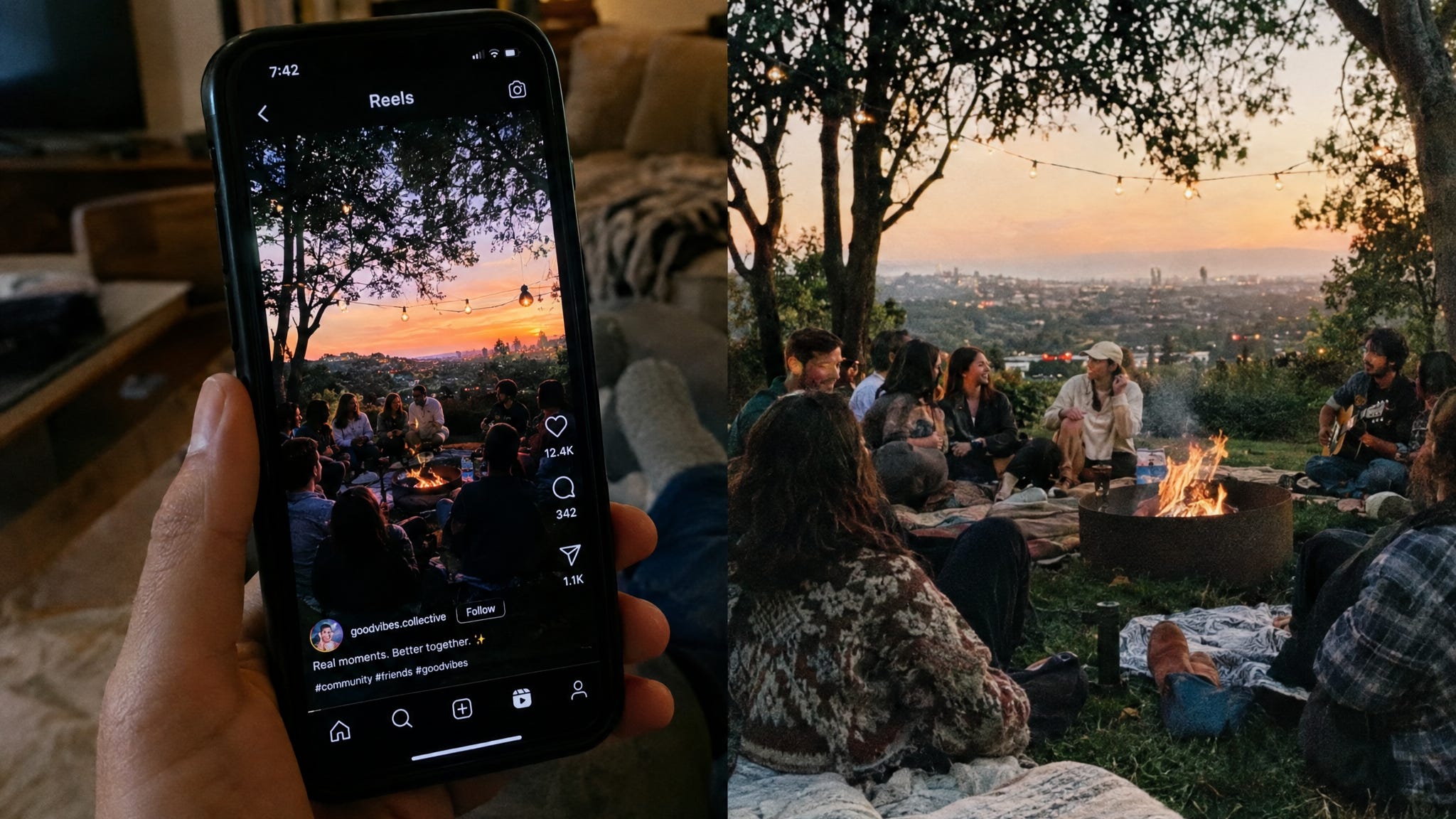
The Overhyped Big World
Funny thing about the internet: it’s intangible.
Through these screens, we experience things that are real (and, increasingly, much that is altogether not real), but that we cannot reach out and touch.
We experience life online, but we also don’t. We experience a strange sort of half life, a reduced reality no matter how real the elements in front of us.
We listen to a speech we cannot respond to in collectively audible applause—no swelling thunder as a moment sweeps the room and words settle in our hearts.
We hear songs that we cannot synchronously sway to in concert halls among others, lacking the shared joy of beauty and art experienced with others.
We see evils that we cannot physically respond to, genocides which we can mostly only rhetorically oppose (and much of that is reduced to the medium of digital 1s and 0s, too).
We view sermons or “participate” in worship while missing the physical presence of the Spirit moving in that room, or perhaps without noticing the eerie lack thereof.
We (all too often) engage in a cheapened and dehumanized version of sexual intimacy—using pornography to make use (and abuse) of a global harem—the scale of which would astound Solomon himself—of exploited, manipulated, or deceived participants on screen, falling victim to the very same temptations of boundless sexual excess that undid the wisest man to ever live.
We live in a world disembodied. A world largely reduced to gnostic experience. And it’s killing us.
This 21st-century world is one in which knowing , experience, and life increasingly comes about intangibly as imagery and sounds are downloaded into our minds across the 12 inches spanning between our phones and our faces.
In this world, we ‘know’ moreso than ‘experience.’ Reality is filtered through our mind itself moreso than our hands, feet, eyes, and ears.
This is the Big World. It’s certainly real, but our experience of it is less than real. It is not possible for us finite humans to have an entirely real experience of the Big World. We are limited in that way.
As I write this on Thursday morning, October 22nd, in my home office just south of Charlotte, NC, I can assure you that I am real, the coffee I’m sipping is real, and the keyboard with which I’m typing these words is a real, lovely mechanical keyboard that crackles with the tsk-tsk-tsk-tap of fingers on keys (a sound which my wife does not enjoy, but which I find immensely satisfying).
But I’m also less than real to you (unless you’re one of my IRL friends reading), because we are not engaging in “real life” together.
We need the Little World for that.
The Little World Where Life Happens
Right now, I’m typing, not speaking.
You can’t look to me inquisitively as I mention that 2nd century heresy of “gnosticism” as present in our modern day, followed by a prodding “What do you mean by that?”
I can’t respond with a mischievous smile as I shift in my seat, lean forward, and unload this contemplation I’ve been sitting on and mulling over for the better part of two years.
You can’t poke holes or, on the flipside, carry the argument to lengths that begin to become uniquely apparent to you, which I then benefit from hearing as well, with us mutually growing together.
We need the Little World for that.
Instead, you can read this in full (hopefully) and, if you so desire, engage in our Big World imitation of this Little World experience: the comment.
And perhaps I respond and perhaps we do have some sort of mutually beneficial back and forth.
But that digital imitation of little world conversation is still just that: an imitation. Digital dialogue is a shadow of the real thing.
Yet, increasingly our lives occur in these Big World digital spaces, to the neglect of the real—to the neglect of the Little World.
God Made Us for the Little World
As a Christian, it’s notable to me how very intentional God was about constantly reminding us humans of the physical context which he created us for.
For Ancient Israel, he didn’t just command disembodied observance and ideas of what holy life consisted of. He gave them embodied rites, rituals, buildings, and spaces (with sometimes extremely specific instructions), through which they were supposed to physically mirror Heaven (literally, in the case of the tabernacle).
For observance of Passover, God didn’t just tell them to remember what happened, but to observe the way in which God provided for them by materially repeating the sacrifice and partaking in the Passover lamb, not once or twice, but every single year.
Even words they were to remember, God instructed them to bring into material reality.
“Love the Lord your God with all your heart, with all your soul, and with all your strength. These words that I am giving you today are to be in your heart. Repeat them to your children. Talk about them when you sit in your house and when you walk along the road, when you lie down and when you get up.
Bind them as a sign on your hand and let them be a symbol on your forehead. Write them on the doorposts of your house and on your city gates.”
- Deuteronomy 6:5-9 CSB
For Christians looking to the New Testament, God gave us three embodied gifts of baptism, the eucharist, and his Church.
God didn’t just tell us to believe in Christ and be saved, but to be baptized and be saved. God gave us a physical act to serve as a necessary embodied mirror to the immaterial spiritual belief.
God didn’t just tell us Christ’s sacrifice was attributed to us through faith, but gave us the Eucharist so we might physically partake of the flesh and blood of Christ in the same way the Ancient Israelites partook in the flesh of the Passover lamb and thus partook in its sacrifice themselves.
God didn’t just tell us what was intellectually or spiritually true in some immaterial way, but gave us instruction for Heavenly action and embodiment of that truth, and a Body of fellow citizens of Heaven to pursue this alongside as the embodied hands and feet of Christ himself, materially embodying our faith in a shared reality which necessitates both giving and receiving of love (and every other fruit of the Spirit) collectively.
Live in the Little World
I’m not telling you to go utterly offline. After all, you wouldn’t even be reading this if you did! But I am increasingly convinced that all of us would benefit from less time in the Big World, and more time in these Little Worlds God has granted each of us.
Less time watching funny kid videos, more time making funny moments with my kids.
Less time watching sports teams we identify with our local pockets of geography, more time playing sports with others in our local pockets of geography (or perhaps coaching your kids’ teams in those sports).
Less time listening to politicians who tell me all the reasons I need to fear my neighbor (who they do not know), more time loving my neighbor (who I need to get to know).
Less time watching sermons and celebrity pastors online, more time discussing sermons from local pastors with the believers we do life with.
Less time arguing the finer details on secondary issues that are primarily immaterial in their effect on lived reality, more time living the reality Christ prescribes as paramount in his own parable of Sheep and Goats (Matthew 25:31–46).
Heck, even just less time consuming media solo, more time partaking in media, arts, and beauty with real life friends and family together.
I think we oftentimes go to the Big World because we want to know and be known. Friend, you have to go to the Little World for that.
Last year around 10 million people saw my face in one or another of my reels. And I can tell you that looking at that Big World vanity metric in my analytics dashboard doesn’t make me feel one lick more known.
But when I’m in a room with 10 men from my church chatting life, sharing burdens, and eating good food, experiencing the Little World in tangible community? Yea, that’s real life. That’s the life we’re made for.
My offline world as a seriously ill housebound person is limited to receiving delivered shopping, having medics visit- and, occasionally, my daughter. There is no progressive church in my area. I can't be present physically, so online experience allows more than I could have accessed even twenty years ago.
Our Bible studies actually started with a small group gathering in a living room every Thursday night, so this really resonates. I love that the internet lets us share Scripture and connect with people we'd never otherwise meet, but there's something irreplaceable about actually sitting around a table and figuring out how to live it out together.