


If you’ve spent any time in church, you’ve likely heard the Beatitudes. They are the opening lines of Jesus’ most famous sermon, and they sound poetic, comforting, and familiar.
“Blessed are the poor in spirit, for the kingdom of heaven is theirs.
Blessed are those who mourn, for they will be comforted.
Blessed are the humble, for they will inherit the earth.
Blessed are those who hunger and thirst for righteousness, for they will be filled.
Blessed are the merciful, for they will be shown mercy.
Blessed are the pure in heart, for they will see God.
Blessed are the peacemakers, for they will be called sons of God.
Blessed are those who are persecuted because of righteousness, for the kingdom of heaven is theirs.”
Matthew 5:3–10, CSB
See that word repeated over and over? “Blessed.”
As modern Westerners, we have a very specific cultural definition of this word. To us, being “blessed” usually means being favored by God in tangible ways. When we scroll through social media and see someone claim they are #blessed, it’s typically accompanied by a picture of a new car, a promotion, a happy family, or a vacation sunset. We think of abundance, wealth, and security.
But there is much more happening here than our modern vocabulary suggests. To understand the shock of what Jesus was actually saying, we have to look at the Greek word underneath the translation.
Defining Makarios
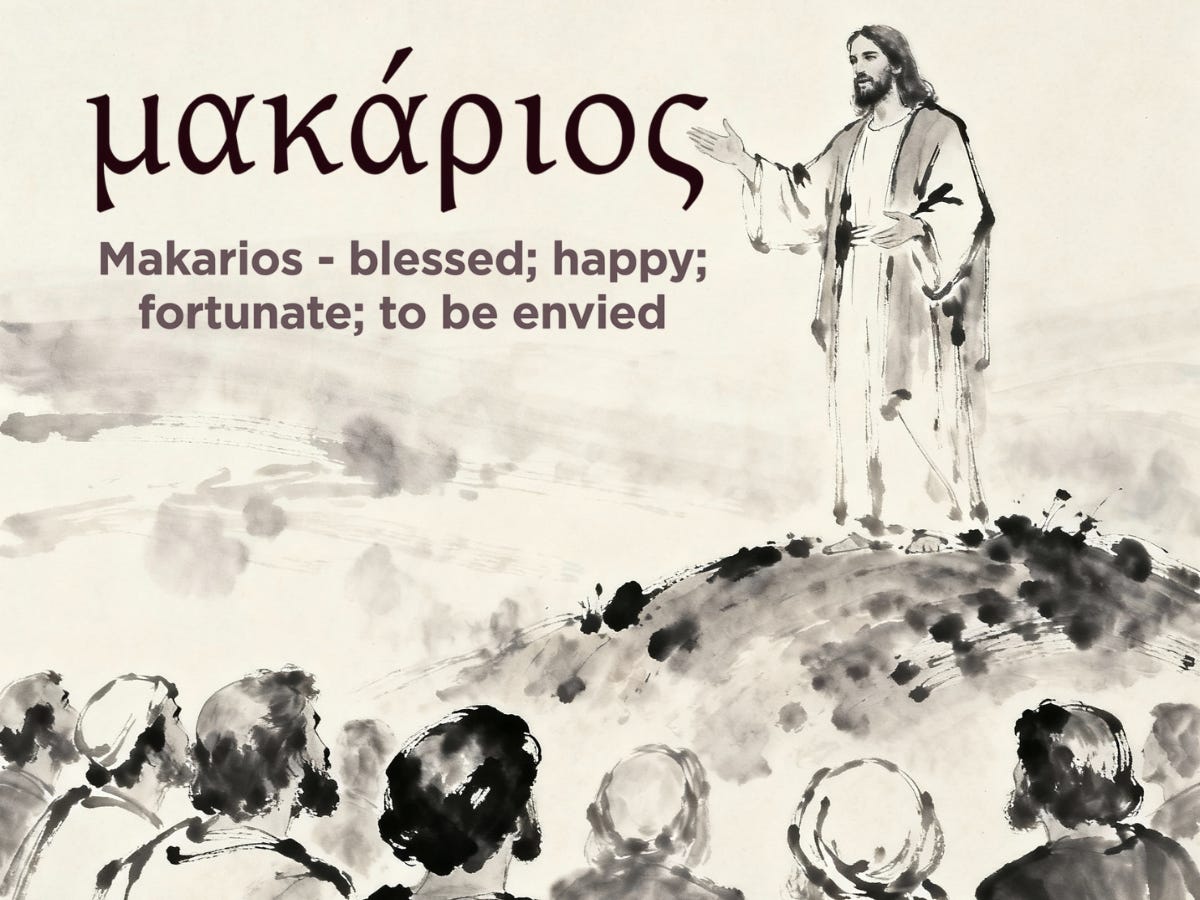
The word Jesus uses in Matthew 5 is “makarios.”
While it is correctly translated as “blessed,” it carries a wider nuance. It can also be translated as “fortunate,” “happy,” or even, “to be envied.”
In Ancient Greek culture, makarios wasn’t a word used for just anyone. It originally described the blissful state of the gods—beings who were above the cares of the world. Over time, society began using it to describe the human elite: the wealthy, the powerful, and the untouchable.
These were the people who were makarios. You looked at the rich man living in luxury and thought, “I envy him. He has the good life.”
This word was certainly not fit to describe the poor, the mourning, the submissive, or the persecuted.
The Great Reversal
This is where Jesus turns the world upside down. He takes a word reserved for the elite and the gods—a word meaning “to be envied”—and applies it to the people society pitied the most.
The humble (meek) are to be envied? That wimpy guy who needs to stop letting people trample all over him?
The pure in heart are fortunate? The guy who got passed up for a promotion because he refused to bend the numbers a bit?
The persecuted are living the good life? C’mon. Who in their right mind sees someone suffering for their faith and thinks, “Wow, if only I could be so lucky as to have a life like that?”
And yet, that is exactly what Jesus is saying.
He is teaching us that the measures, weights, and priorities we use in this world are not the measures and weights of the Kingdom of Heaven. In the Kingdom, the hierarchy is inverted. God’s Kingdom is upside down.
A New Definition of Success
Jesus wants his audience—and us—to look at the merciful, the peacemakers, and those hungry for righteousness and say, “Man, that is the life. I want more of that.”
He wants us to recognize that living that life is the path to fulfillment, blessing, and the true meaningful goals of life.
Take a look at verses 11-12:
“You are blessed when they insult you and persecute you and falsely say every kind of evil against you because of me. Be glad and rejoice, because your reward is great in heaven. For that is how they persecuted the prophets who were before you.”
Fortunate are the persecuted? They’re to be envied? Well, when you have Kingdom priorities, maybe so, and not only for the anticipated reward, but also for the confidence Christ brings in this present life; the confidence we can have in his promises of good in the end.
The natural human instinct is to envy the powerful and the wealthy. The Kingdom instinct is to envy those who have such deep security in God that they can endure persecution with joy. Do you envy those who have that kind of security of faith?
Some things to consider, eh?
So, Christian, beware of the voice in our culture that denigrates these traits as “weakness.” In Christ’s Kingdom, the people practicing these things are the truly successful ones. They are makarios; fortunate, blessed, and the ones truly to be envied.
Thank you. I offer an alternative:
From an Anglican perspective, we would respond quite differently to the idea that “the meek are to be envied - that wimpy guy who lets people walk over him.” The Beatitudes use the Greek word makarios, often translated “blessed,” but it carries a deeper sense than happiness or good fortune. It points to a state of grace - a life aligned with God’s reign.
In the Christian tradition, meekness (praÿs) is not weakness or passivity. It is the virtue we see in Christ Himself - strength that is disciplined, humble, and surrendered to the Father’s will. The meek person is not crushed or powerless; rather, they are one who chooses gentleness over domination, peace over violence, trust over self-assertion.
Meekness reflects:
a heart shaped by prayer and humility before God
a refusal to repay injury with injury
solidarity with the vulnerable and oppressed
confidence that justice ultimately belongs to God
This aligns with the Anglican (Episcopalian) emphasis on spiritual formation, holiness of life, and the imitation of Christ. In the Beatitudes, Jesus is not praising timidity, nor encouraging people to be trampled on. He is revealing the character of those who belong to the Kingdom already breaking into the world.
To say that the meek are blessed is to affirm that:
Those who entrust themselves to God rather than grasping for power already share in the life of the Kingdom, and will inherit the earth
not by force, but by love.
Beautiful! I spent all of 2024 focussing on the Beatitudes at my sub stack. I get so excited whenever I see someone writing on that passage.
Once I started seeing Jesus in the Beatitudes my mindset changed. To be makarios, to be happy, to be blessed, is to be like God, to be godly. Here Jesus tells us that Jesus's life isn't accidental. Jesus purposefully chose his life because it was in line with his character. Jesus is poor in spirit. Jesus does mourn. Jesus is meek. Jesus hungers and thirsts for righteousness. Jesus is pure in heart. Jesus is a peacemaker. Jesus is persecuted.