

A Worst Case Scenario for War
Death ground.
While it may sound like a heavy metal band name, this is a concept any student of war or diplomacy should be aware of, along with its corresponding cousin: the golden bridge.
Right this moment, the Iranian regime is standing on death ground, and if we don’t build a golden bridge with them in negotiations, many more will die than necessary.
Let me explain the basic scholarship on negotiation I wish our present leaders understood.
An Ancient Principle of War
Over 2000 years before Donald Trump wrote The Art of the Deal, a Chinese general and strategist, Sun Tzu wrote The Art of War. Today, The Art of War is commonly cited in war and diplomacy curricula. In fact, it is listed as one of THE West Point History Department’s Top 10 Military Classics.
Many an officer in the US military has read this book.
In Chapter 7, paragraph 36, Sun Tzu writes, “When you surround an army, leave an outlet free. Do not press a desperate foe too hard.”
A surrounded foe with no way out stands on death ground. And if you press them rather than providing an outlet they view as preferable to death, they will fight you with every ounce of might in their body.
(Side note: This is why it is really dumb for our “Secretary of War” to say that we will offer “no quarter” and “no mercy” in this war. You want people defeated in battle to surrender, not fight to the death.)
In Chapter 11, Sun Tzu further writes on this concept of death ground, or desperate ground, even communicating that it can be ideal to place your army upon it intentionally, as “it is the soldier’s disposition to offer an obstinate resistance when surrounded.”
An Ancient Example
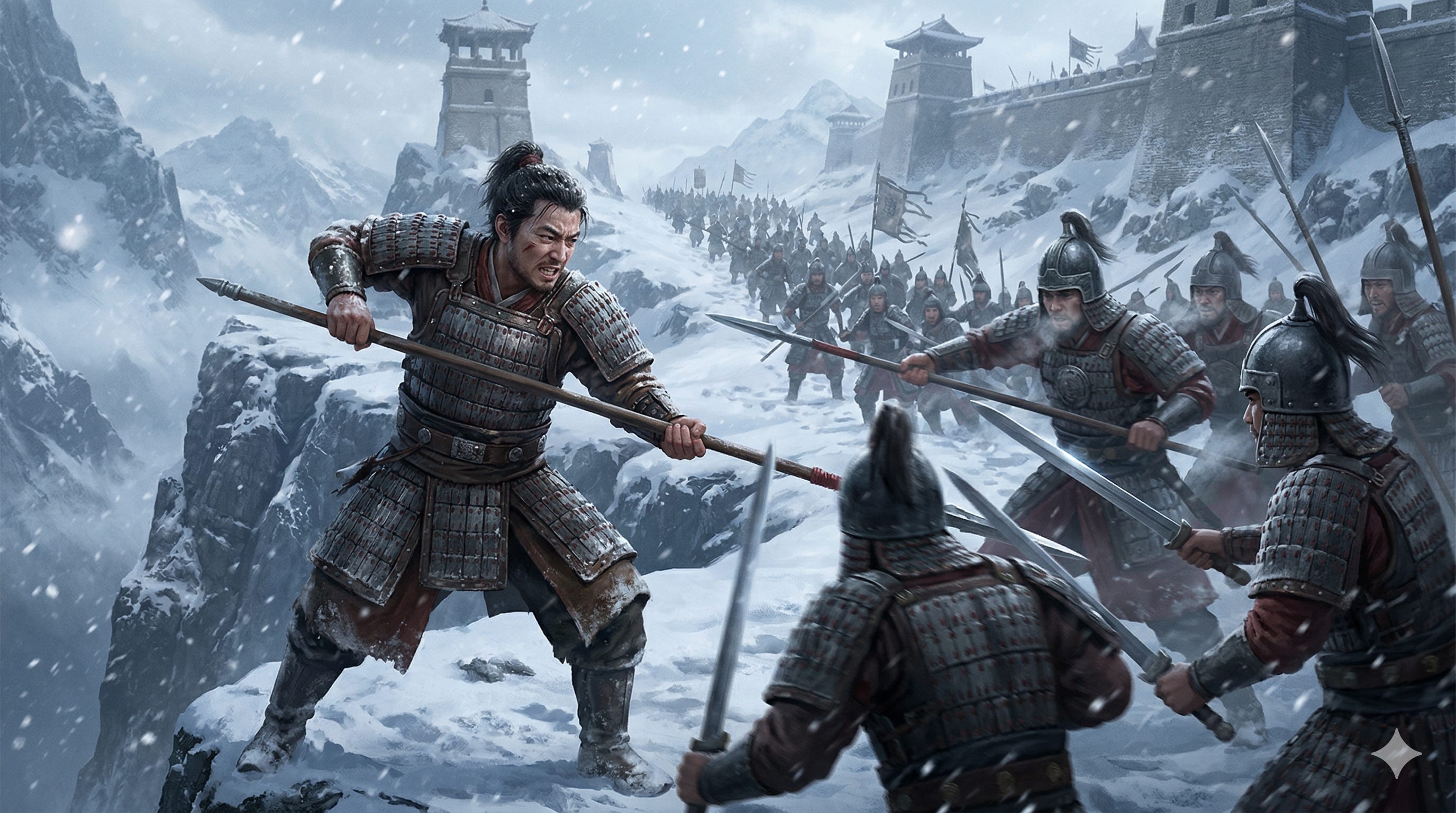
This is actually precisely what Chinese General Han Xin did in 205 BC (several hundred years after Sun Tzu’s life), when he placed his army of 30,000 men with their backs to a river bank as they fought off 200,000 in the Battle of Jingxing. The 30,000 fought valiantly, drawing the full force of the opposing Zhao army into combat. Simultaneously, a mere 2000 cavalry under Han Xin’s forces descended from flanking mountains and raised their flag in the enemy camp, causing a panicked retreat among their enemies.
The battle’s outcome gave rise to a Chinese idiom, “fighting a battle with one’s back facing a river” (背水一战), which is used similarly to the American idiom of “do or die.”
No one fights so viciously as a foe whose only other alternative is destruction. The last thing you want in war is to place your foe upon clear death ground and then press him. That will go bloodily for them, sure, but likely also for you. And it just might actually work against you altogether.
We’re Pressing An Enemy on Death Ground
This isn’t just relevant for battles, but also at the level of strategic negotiation.
Before this war with Iran had even begun, we had maneuvered the Iranian regime onto death ground. Our sanctions had their economy in a freefall. Our military pressure had been steady and growing. A valuable goal would have been to use that pressure to push them to the outlet of your choosing, building what William Ury, cofounder of the Harvard Program on Negotiation, calls “a golden bridge.” Instead, we chose to engage in a full on military conflict just as negotiations appeared to be making progress.
With the launch of this war, we began to close in on the enemy we’d placed on death ground. Our previous pokes and prods (even our bombing campaign last summer) were not intended to push the enemy off the precipice, were not intended to directly destroy them, but merely to pressure them and achieve limited objectives.
They likewise responded by more or less by simply swinging their swords in our direction, launching strikes they knew would be neutralized easily enough. Their response was more in-line with saving face in their honor/shame culture and building a narrative of response they could feed to their people than an actual military threat.
But now that we truly are attempting to force them off the cliff, we risk them attempting to cut their way through us, desperate to go out with a fight, take as many down with them as possible, and perhaps find some sense of victory in the obstinance of their resistance.
So What Now, Then?
So what’s the solution?
Your suggestions of peace have to be better than continued war. You have to provide a serious outlet. Peace needs to bring benefits for both sides, especially now that blood has been spilt.
In war, you must either crush your foe altogether or, absent that capability or will to engage in such a costly fight, find a peace that meets some form of mutual criteria. The problem is, everyone engages in peace talks with the goal of either a) avoiding worse outcomes or b) gaining better outcomes.
We already played our cards, though. We began the war with killing the “Supreme Leader” and much of his inner circle. We’ve bombed much of their infrastructure they’d otherwise want to preserve. We’d strangled their economy before we even began the war.
The question now is: What does the Iranian leadership have left to lose? What remains on the Iranian side of the ledger? If the answer is “nothing,” then we aren't just fighting a regime; we are fighting an entity that sees resistance to the point of death as its only remaining path to either honor in death or continued future life of any quality. If they perceive they have nothing left to lose, their strategic calculus shifts from survival to “obstinate resistance.”
The paradox of our current position is that the 'sunk costs' of the conflict have made the price of diplomacy exorbitant. We have no appetite for the concessions peace would now require. The blood and destruction already inflicted don't disappear at the negotiating table—they become demands for compensation, security guarantees, and pledges of non-aggression that we simply aren't willing to make.
This piece isn’t about whether it would be tactically useful or morally valuable for us to have avenues to continue future military pressure against the despotic regime. It’s simply about what terms realistically would or wouldn’t satisfy negotiations in which both sides hold agency and have their own interests to meet, and their own forms of “death ground” to avoid.
In our arrogance, I worry we’re determined to avoid the concessions that would be required to accomplish such a negotiation, and we didn’t begin this war with thought as to how it might end absent the physical removal of this regime from power. With that in mind, I worry our leaders are determined to fight our opponents at this precipice, no matter the cost.
And that just might mean boots on the ground against a desperate foe.
By demonstrating too much force, too quickly, against an ideologically driven foe now eager to save face and avoid destruction, we’ve placed ourselves in quite a predicament, with an opponent on “death ground” with whom we are unwilling to build a path to deescalation.
One of my professors (and a veteran himself) gifted me a copy of Sun Tzu when I graduated from college. I only got about a third of the way through before life took over, but I've been meaning to go back and finish it. Thank you for the prompt (and the clarifying editorial).
Thank you for your article.
While it presents an interesting strategic perspective using Sun Tzu’s concept of “death ground,” it overlooks a critical reality: the nature of the Iranian regime itself. This is not simply a conventional adversary responding rationally to pressure in the same way a traditional state might. The current government of Iran has a long, well-documented history of suppressing its own people—particularly women, religious minorities, and political dissenters—through executions, violence, and public displays of punishment.
It is essential to distinguish between the Iranian people, many of whom desire freedom and reform, and the ruling regime, which has repeatedly demonstrated hostility not only toward its own citizens but also toward the United States and its allies.
Framing this conflict primarily as a negotiation misstep risks minimizing the deeply rooted ideological motivations that drive the regime’s behavior. While academic frameworks often emphasize negotiation theory, real-world military and strategic education—such as that taught in U.S. war colleges—tends to present a more complex and, at times, less optimistic view of adversaries like this one.
I do have a question for the author: what gives you the impression that Iranian leadership was genuinely willing to negotiate? The United States and other nations have attempted negotiations with this regime for decades, including sustained and recent diplomatic efforts. Yet these attempts have frequently been met with limited cooperation, delay tactics, or outright resistance. This raises serious doubts about whether traditional negotiation strategies—such as offering a “golden bridge”—are realistic in this context.
Additionally, the regime’s demonstrated disregard for both American lives and its own citizens complicates the assumption that pressure alone drives its decision-making. Reports of military or weapons-related infrastructure being positioned adjacent to civilian areas, including schools, suggest calculated choices that increase risk to innocent people. This is not the behavior of a government primarily seeking mutual stability; rather, it reflects leadership willing to accept—or even leverage—civilian vulnerability in pursuit of its objectives.
While strategic restraint and diplomatic off-ramps are valuable in theory, they may not be effective when dealing with leadership that prioritizes ideological goals and regime preservation over mutual benefit. Any serious analysis must account for this reality, and its absence in the article is notable.
At the same time, it remains important not to conflate a regime with its people and to consider the human cost of escalation. From a faith perspective, there is also a call to pursue both truth and justice—recognizing evil where it exists, while still valuing human life and seeking wise, measured responses rather than reactionary ones.
Ultimately, the situation is far more complex than the article suggests. It requires not only strategic insight, but also moral clarity, discernment, and an honest recognition of the kind of adversary being addressed.