


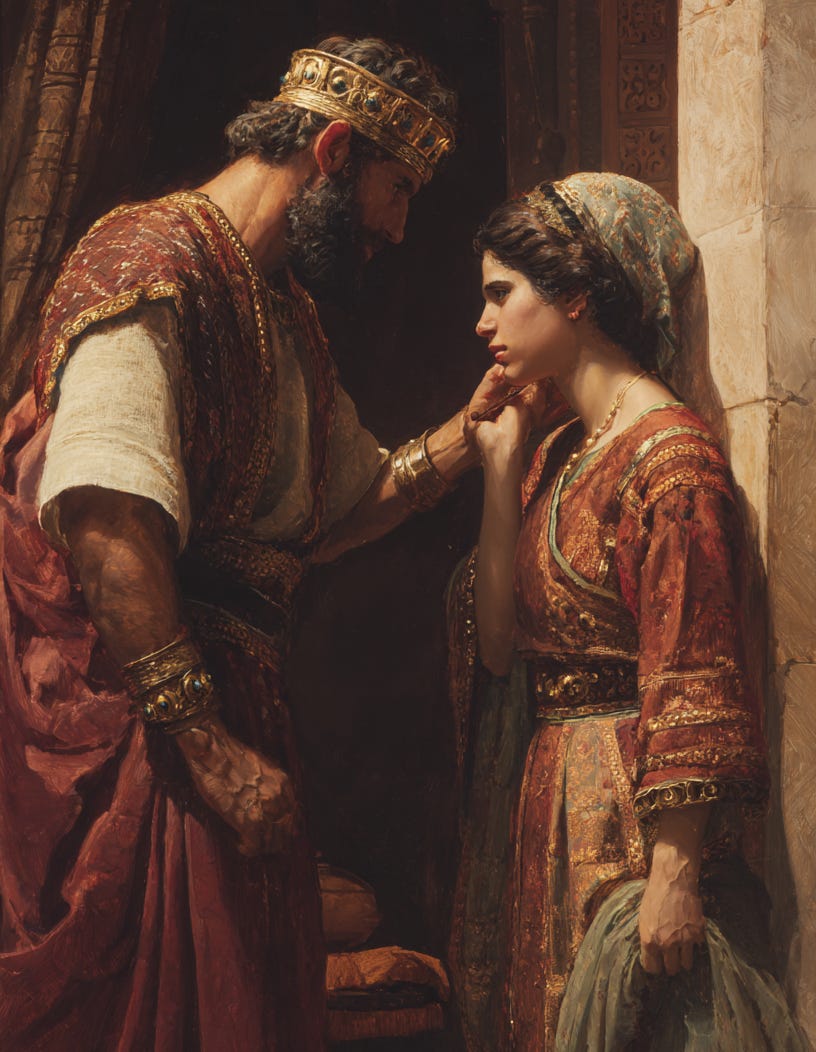
You know the story of David and Bathsheba, but do you know the revenge narrative that follows it?
If you grew up in Sunday School, you probably think you know the story of David and Bathsheba. It’s often framed as a cautionary tale about the spiraling danger of sin, and sometimes even twisted into a narrative of seduction. In a version of the story common to Evangelicalism, Bathsheba is cast as a temptress, or at the very least, a willing participant in a scandalous affair.
But if you don’t know the revenge narrative that follows in subsequent chapters of 2 Samuel, you’re missing some key clues as to the nature of what really happened to Bathsheba.
To understand what actually happened between David and Bathsheba, adultery or r*pe, we have to talk about a man you’ve likely never heard of: Ahithophel. He is the linchpin that turns this story from a possible love affair into what seems to be a fairly plain case of sexual abuse.
Add in some core takeaways from Nathan’s parable and, between that and Ahithophel’s counsel, the case is closed. Let’s dive into the text.
First, Let’s Get Past Arguable Details
Before we get to the “smoking gun,” let’s briefly address common arguments around the narrative and why I’m not referring to them here.
Arguments fly back and forth regarding the Hebrew phrasing and grammar in 2 Samuel 11. Some point out that David “sent messengers and took her” (2 Samuel 11:4), emphasizing a forceful seizure of a subject by a king by (likely) armed guards. Others counter by looking at the book of Ruth, noting that Boaz “took Ruth and she became his wife” (Ruth 4:13), or pointing out that Bathsheba “came to him” (2 Samuel 11:4).
People go back and forth over whether details in the text point to either Bathsheba’s innocence or culpability: Why and where was she bathing? Were the “messengers” sent to her armed guards? Could Bathsheba have said no to David as King?
But, in my opinion, these arguments can easily devolve into unnecessary distraction when two very clear clues are given to us in the chapters of 2 Samuel following David’s sin.
Clue #1: The Parable of the Lamb
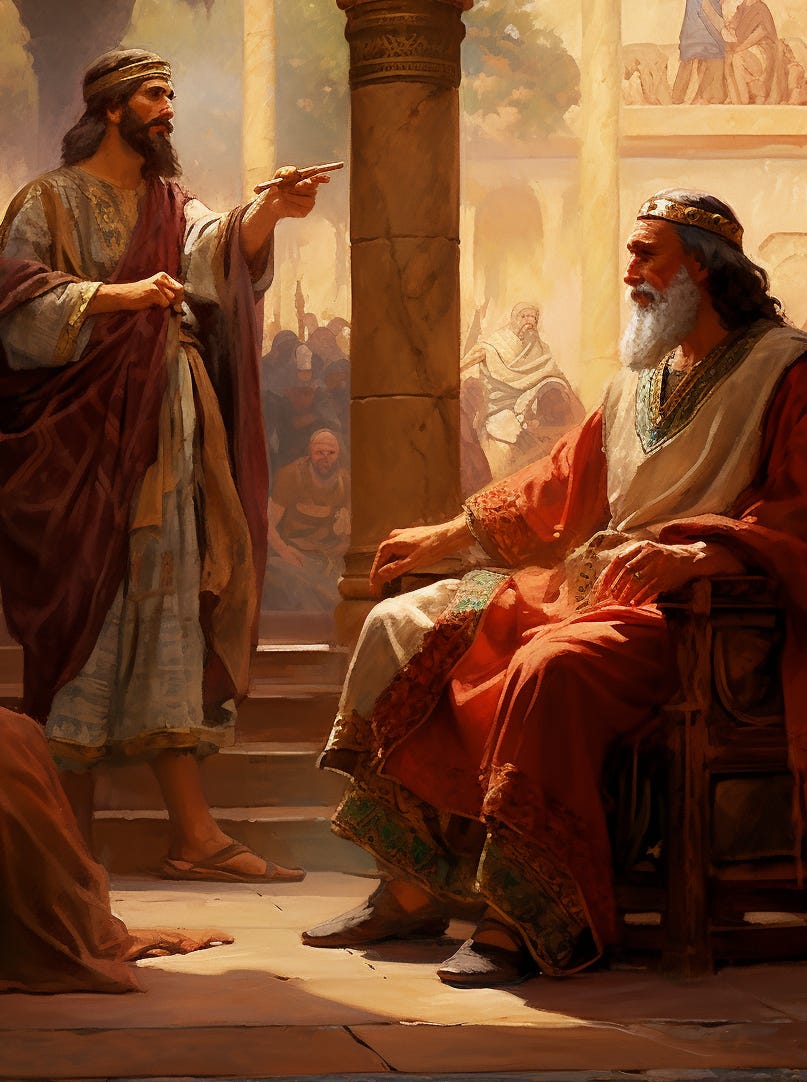
Immediately after David’s sin, the Prophet Nathan confronts him with a brilliant, devastating parable in 2 Samuel 12:1-4.
Nathan tells David about two men: one rich, with many flocks, and one poor, who had nothing but one little ewe lamb that he had bought and brought up. The text says the lamb “ate of his food and drank from his cup and lay in his arms, and it was like a daughter to him.”
When a traveler comes to the rich man, the rich man refuses to take from his own flock. Instead, he takes the poor man’s lamb and “prepares” it for the guest. In other words, he slaughters it.
Ask yourself: In this narrative, who is the lamb? The lamb is Bathsheba. Does the thief in the story love the lamb and cherish it as a beloved addition to his flock? No. He slaughters it for reasons of appetite and convenience.
So, is the lamb (aka Bathsheba) a sinful participant in its own slaughter, or is it a victim?
By using this specific metaphor, the Holy Spirit—through Nathan—defines Bathsheba not as an adulteress, but as a “precious thing” that was stolen and consumed by a man who, blessed as he was, needed to seize even more to meet an unquenchable appetite.
Yet, some, like the author of this Got Questions article, still want to defend David from the accusation of the specific sin of “r*pe.”

In their effort to justify David, they’ll twist themselves into knots, even creating entirely manufactured third categories of “took advantage” rather than simply calling David’s sin what it was.
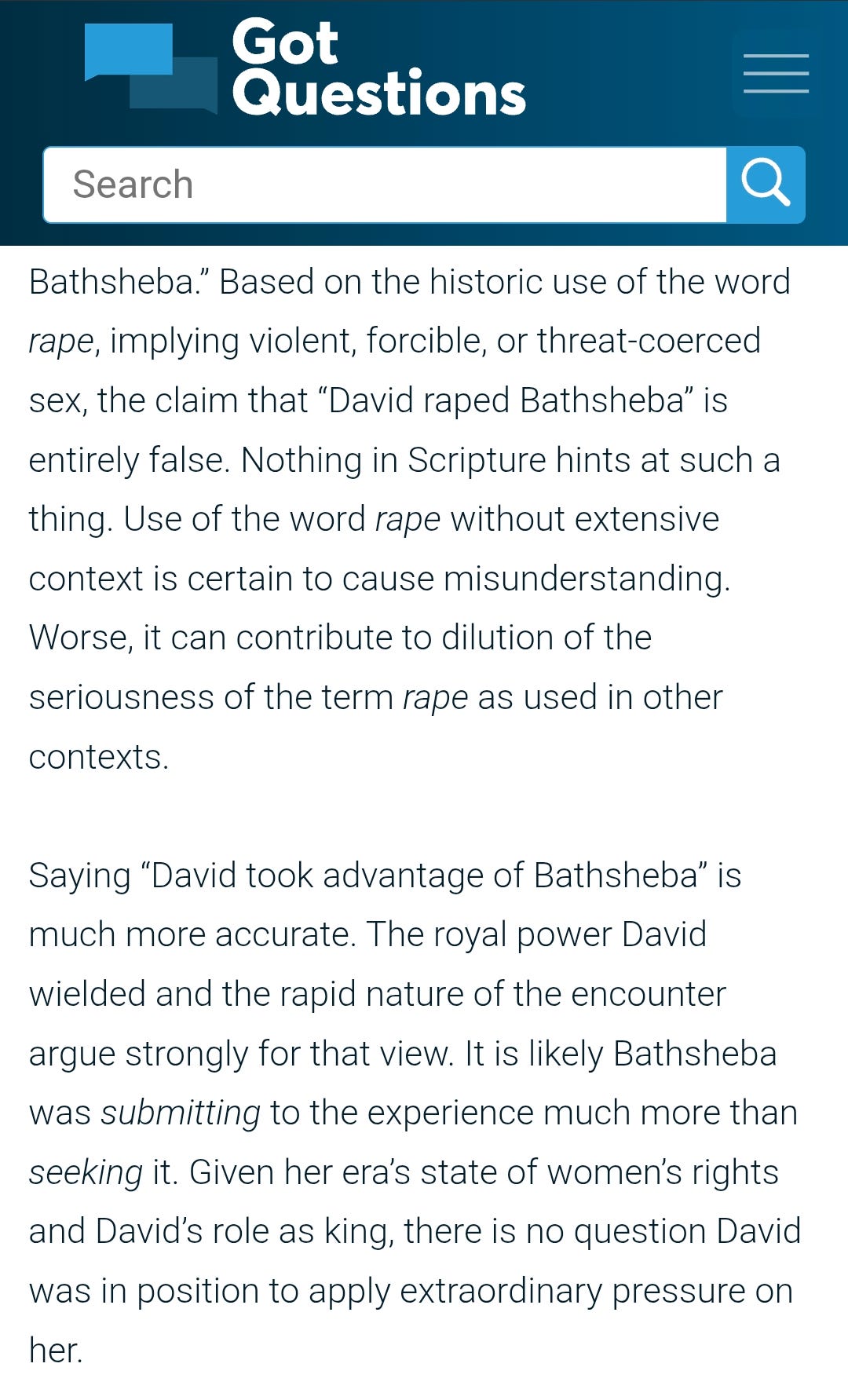
Well, when you look at the narrative of Ahithophel’s vengeance, even that weird distinction falls apart.
Clue #2: The Revenge Narrative
This is where the story gets incredibly dark and incredibly precise. Enter Ahithophel.

Ahithophel was one of King David’s most esteemed advisors. 2 Samuel 16:23 says his counsel was as if one had “consulted the word of God.” But in 2 Samuel 15-16, we see Ahithophel serve as a bitter enemy to David, allying with his rebellious son, Absalom. Why?
Well, let’s do some “detective work” in the genealogies:
In 2 Samuel 11:3, we learn that Bathsheba is the daughter of Eliam.
In 2 Samuel 23:34, when listing David’s “Mighty Men,” we find: “Eliam the son of Ahithophel the Gilonite.”
Ahithophel was Bathsheba’s grandfather.
When David “took” Bathsheba and murdered Uriah, he didn’t just commit a sin in a vacuum; he decimated a family in his most loyal inner circle. He took the “ewe lamb” of his own advisor’s household, disgracing her father and killing her husband in the process (both of whom had likely served with him for years, potentially even before his kingship, given their labels as members of his Mighty Men).
The Vengeance of the Grandfather
Fast forward years later. David’s son, Absalom, leads a rebellion against his father (2 Samuel 15). If you’re unaware of his relation to Bathsheba, Ahithophel defects from David seemingly randomly to join the rebellion.
But we’re not unaware of that connection, and that connection is important to note in exactly what Ahithophel advises Absalom to do.
Ahithophel’s advice to Absalom is chillingly specific. He tells him to ““Go and sleep with your father’s concubines, for he has left them here to look after the palace. Then all Israel will know that you have insulted your father beyond hope of reconciliation, and they will throw their support to you.” So they set up a tent on the palace roof where everyone could see it, and Absalom went in and had sex with his father’s concubines.” - 2 Samuel 16:21-22
At first glance, this looks like a political power move. But in the context of the family history, it is a calculated “mirror” punishment. Ahithophel is directing David’s own son to do to David’s wives in public what David did to Ahithophel’s granddaughter in private.
This exact evil was predicted by Nathan in 2 Samuel 12:11-12: “I will take your wives before your eyes and give them to your neighbor... For you did it secretly, but I will do this thing before all Israel.”
Conclusion: Seeing Through the Narrative
If Ahithophel’s revenge was a mirror of David’s crime, then we have to accept the reflection.
What Absalom did to those concubines was, by any modern or biblical definition, sexual assault. If the “repayment” for David’s sin was sexual assault, then the “original debt”—what David did to Bathsheba—should logically be categorized the same way.
It’s important to note that the Ancient Near East didn’t use our modern vocabulary for “consent” or “autonomy.” They used categories of property, honor, and theft.
In the ANE, the only actions really categorized as r*pe were forcible physical assault. Other situations of non-consensual sexual relations, due to factors such as intoxication (e.g. Lot’s situation at the hand of his daughters 🤮 or Jacob’s situation with Leah), coercion, threats, or power imbalances (e.g. a king and a subject) were rightly labeled as trickery or wrongs, but wouldn’t be slapped with the same label by Biblical authors as a violent assault, despite the fact that we categorize this all as one crime based on consent/non-consent today.
Individual autonomy simply wasn’t perceived the same way we handle it today. Injustices like those discussed here were considered to be committed not against the woman, but her family as a whole. Additionally, women were viewed essentially as property to their fathers or husbands, so restitution for such a crime against a virgin, for example, included paying a woman’s father and marrying her.
We have to recognize that the Bible doesn’t use our language because it was written by people who simply inhabited a very different world. But it is plain to see that what happened to Bathsheba is what we would categorize as r*pe today. While the Bible doesn’t use that word, it does present her as a victim, not a participant in David’s sin.
The narrative structure is clear. Bathsheba wasn’t a “femme fatale,” as often portrayed in Hollywood and many a Bible study. She was a woman caught in the crossfire of a powerful man’s appetite.

This matters for the Church today, because how we see Bathsheba will be reflected in how we perceive and treat victims of sexual abuse (and their abusers) in our own churches today. Will we excuse victims and try to paint their situations as mutual sins between two people? Will we even go so far as painting victims as intentional seductresses? Or will we protect victims and confront their abusers, just as Nathan did in 2 Samuel?
Our perspective on this story, just like others in the Bible, will logically bleed into our real lives.
What do you think? Were you aware of these connections in the story? Let me know your takeaways or thoughts in the comments!
Excellent assessment.
While I was aware of most of this, I had never put together the Ahothophel connection, so thank you for that.
Interestingly though, the vocabulary used in the Greek Septuagint supports the view that David is the sole perpetrator of the sin. It emphasizes his abuse of power and active pursuit, while portraying Bathsheba as a victim of his actions. And even more interesting is that the Greek makes it clear that she wasn't just "bathing" but actually performing a ritual cleansing/purification.
Excellent article. I find contemporary Christians don’t seem interested in or have the mental or emotional constitution to approach such things. It is easier to whitewash certain aspects so they don’t have to face the bitter truth of it. Great job!!!