



As I create content pulling from Scripture and elucidating different elements of the text, folks often ask me what my preferred Bible translations are. I have three top translations, personally:
The NRSV, which I love for being influenced by a variety of Protestant, Catholic, and Orthodox scholars. I know I’m going to get nuanced and informed translation with that text, pulled from a diversity of views.
The CSB, which is my everyday reader. This translation holds a strong balance between “thought-for-thought” and “word-for-word” approaches to translating the message of the text, and is informed by some excellent scholarship, although by a selection of scholars more narrow in their background.
The NLT, which I enjoy for both “easy reading” and in contrast with other translations to help decipher the actual message of particularly wordy or complex portions of Scripture. Being a scholarly approach to a more “thought-for-thought” translation, the NLT is both lighter reading and helps make sense of challenging passages.
When reading Scripture in any translation, though, it’s always useful to be aware of their weaknesses and limitations. I was reminded of this particularly acutely one July morning five years ago. For a reason I don’t remember, I had been reading through both the ESV and the NLT versions of a passage. A discovery I made prompted me to send the following message in my family chat:

The passage in question? Hosea 6:1-2. The problem was that the ESV (and the CSB, NIV, NRSV, etc.) read entirely different than the NLT here. And the difference was significant.
The CSB Reading
In the CSB (which I now find to be a slightly better reading than the ESV, although very similar in this case), the verse reads:
“Come, let’s return to the LORD. For he has torn us, and he will heal us; he has wounded us, and he will bind up our wounds. He will revive us after two days, and on the third day he will raise us up so we can live in his presence.”
Notice something interesting there?
“…on the third day he will raise us up so we can live in his presence.” I don’t know about you, but that reads as pretty prophetic to me.
As we Christians now know, several hundred years after this text was written Jesus was raised on the third day after his death, and through that resurrection we can likewise be raised up to live in God’s presence, having his sacrifice attributed to us through faith.
In fact, some scholars argue that Paul himself is likely referencing Hosea 6:2 when he declares in 1 Cor. 15:3-4 that Jesus’ resurrection on the 3rd day was prophesied in the Old Testament Scriptures.
“For I passed on to you as most important what I also received: that Christ died for our sins according to the Scriptures, that he was buried, that he was raised on the third day according to the Scriptures…”
This additionally appears to be the view of such early Church Fathers as Tertullian, Cyril of Jerusalem, and Jerome.
Contrasting the NLT
The problem is, the NLT omits the specificity of time mentioned in the passage entirely, which is precisely the information from which this potential prophetic meaning would be derived!
In the NLT, the passage reads,
“Come, let us return to the LORD. He has torn us to pieces; now he will heal us. He has injured us; now he will bandage our wounds. In just a short time he will restore us, so that we may live in his presence.”
But the Hebrew doesn’t say, “…in just a short time…” It specifically uses the phrasing of “miyyomayim” (“from/after two days”) and "bayom hashlishi” (“on the third day”). Personally, I think it’s an injustice to the text to translate this passage so imprecisely, especially given the parallels readers steeped in the whole of Scripture are likely to draw.
However, there’s no conspiracy at play here; no ill-intended attempt to quietly bury a Christological reference in the text. The problem comes from the NLT’s dynamic equivalence translation philosophy, which is generally very helpful and respectable.
At times, it makes perfect sense to go with the meaning of the text rather than the letter of the text, as the letter of the text may be nonsensical or misleading for modern readers of different cultures in regard to the original intended message of the author.
For example, many Old Testament passages communicate directly in the Hebrew that God is “long of nose.” Translated “word for word,” this phrasing would be meaningless to an English speaker. However, we know that “long of nose” is a Hebrew idiom translating to “slow to anger.” Thus, the vast majority of English translations tell us that God is slow to anger, not that his nose is particularly large.
The NLT is here taking similar well-intended liberties. In Ancient Hebrew poetry, the use of an amount of numbers plus one (an x, x+1 pattern) was an idiomatic way to communicate a complete total. Below are two examples:
“The Lord says:
I will not relent from punishing Damascus
for three crimes, even four,
because they threshed Gilead with iron sledges.”Amos 1:3
“The Lord hates six things;
in fact, seven are detestable to him:”Proverbs 6:16
It is this idiom that some scholars claim is being applied here in Hosea 6:2. With no true knowledge of Jesus’ future resurrection, neither the author nor his ancient readers would have consciously intended a Christological reading of the text.
However, as a Christian who believes the words of Scripture are divinely inspired, I think it’s just as important to aim for communicating what the Holy Spirit inspired these authors to write as it is to communicate what they understood themselves to be writing.
The principle of sensus plenior argues that understanding Scripture is not just about understanding the human authors’ intents, but also the intent of the singular Holy Spirit who inspired them. As Catholic scholar Raymond E. Brown writes, “The sensus plenior is that additional, deeper meaning, intended by God but not clearly intended by the human author, which is seen to exist in the words of a biblical text (or group of texts, or even a whole book) when they are studied in the light of further revelation or development in the understanding of revelation” (SPSS, 92).
In light of the principle of sensus plenior and the relevance of the specific timing mentioned in the text of Hosea 6:2, I see no reason why this passage shouldn’t be translated in the traditional rendering preserved by the NIV, CSB, ESV, NRSV, and other leading translations, with perhaps a footnote in the page explaining the potential grammatical flourish at play for the original audience.
Unlike “long of nose,” the literal verbiage of being raised “on the third day” and restored to God’s presence does have relevance and meaning for the modern reader in light of what Christ accomplished through His resurrection. It just may differ from what the original author understood his text to be saying.
In Summary
For me, this encounter with divergence between translations served as a helpful reminder on how useful it is to cross-compare various translations of Scripture, especially when closely studying a passage.
The YouVersion Bible App even has a feature through which you can click on a verse and select to compare versions, a feature I frequently make use of. This isn’t a paid partnership, but it is a personal feature recommendation from me!
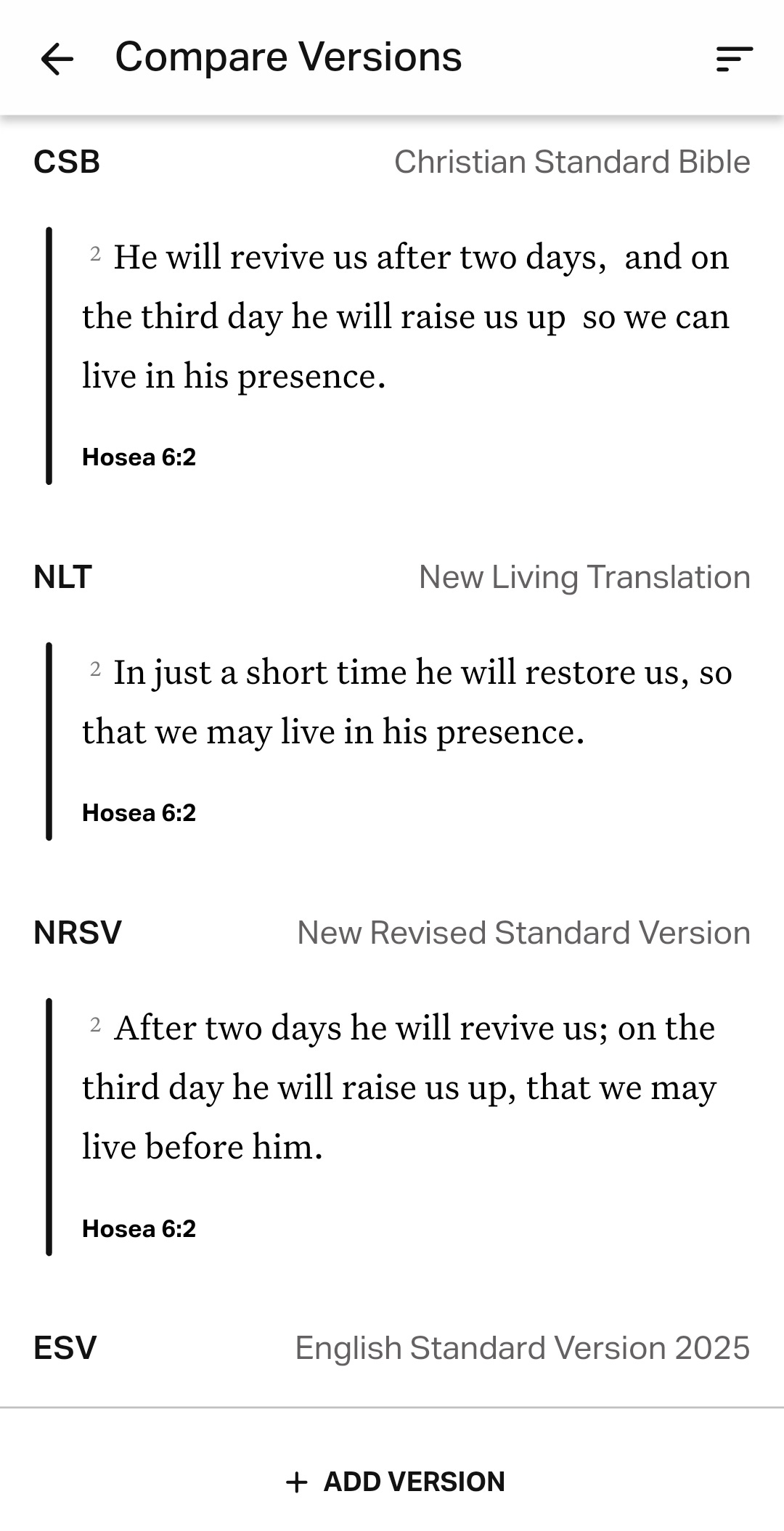
I hope this piece serves as a helpful reminder to you on the true depth of this text we Christians are consulting, and the value in going over some passages with a fine-toothed, multi-translation comb.
Such a good reminder that every translation makes interpretive choices. Comparing versions can show us where wording carries more weight than we realized. Hosea’s immediate message is about Israel’s restoration, while the “third day” language also invites Christians to read the passage in light of Christ’s resurrection. We do not need to choose between context and fulfillment—we need to read carefully enough to honor both.
I had memorized both the “three even for four” and the “six things the Lord hates, seven that are detestable to him” and have noticed this pattern with numbers, but had never understood it. Thanks for that brief insight